Which Trading Confluence Matters Most When Building a Repeatable Setup
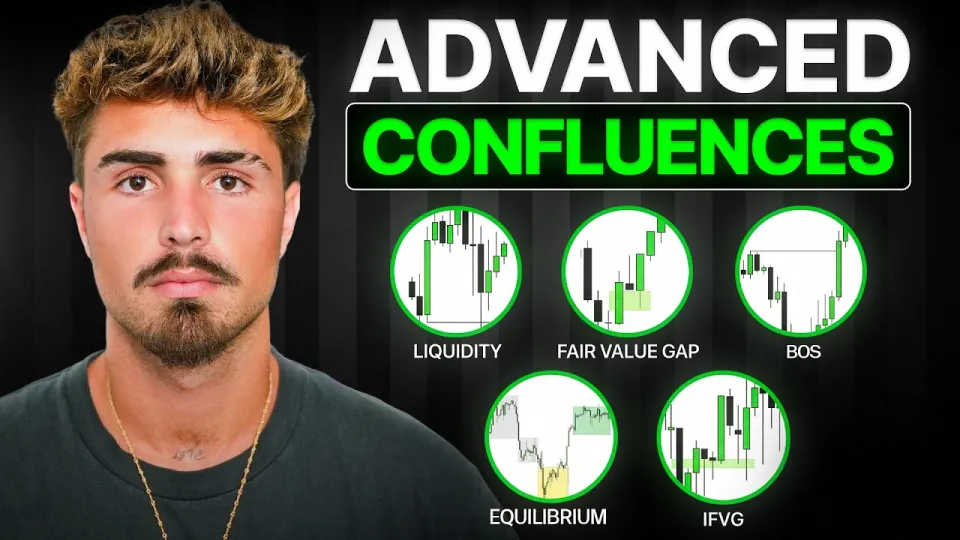
Video: Learn Every Trading Confluence In 18 Minutes
Need articles like this for your video? They help promote it on YouTube and Google — order them in the Telegram bot @sat_sit_bot. It writes articles around your video, embeds the video and publishes them on popular niche websites (no ads). Free trial — 50 articles.
Key takeaways
- Confluence means stacking independent signals (liquidity, FVG, inverse FVG, equal highs/lows, break of structure) so one setup is confirmed by several reasons at once.
- TJR's 18-minute breakdown covers five core confluences: liquidity, fair value gap, inverse fair value gap, equal highs/lows and break of structure.
- More confluences is not automatically better: each added condition cuts the number of trades and can turn a clean setup into curve-fitted noise.
- A fair value gap is a three-candle imbalance; an inverse FVG is the same gap after price trades through it and it flips role.
- Break of structure confirms direction only after a swing point fails, so it lags price and works best as a filter, not a trigger.
Trading confluence is the practice of stacking independent reasons — liquidity, fair value gaps, inverse fair value gaps, equal highs and lows, break of structure — so that a single entry is confirmed by several unrelated signals instead of one. The useful answer is that confluence improves a setup only when each layer measures something different; stacking signals that describe the same thing just narrows your sample and hides the real edge. TJR's breakdown of every core confluence in 18 minutes is a good map of the vocabulary, and the full trader blueprint is where that vocabulary gets turned into a written process.
What trading confluence actually means in practice
Confluence is a filter, not a signal generator. A single pattern such as a fair value gap tells you where price moved too fast; a liquidity sweep tells you where resting orders were taken out. Those are different observations about the same chart, and when they line up at the same price the probability of a reaction is higher than either one alone.
The trap is treating confluence as a checklist to maximise. If you require five conditions on every trade, you will take very few trades and most of them will be the ones that happened to fit — which is how traders accidentally curve-fit their own rules. A workable rule is to pick two or three confluences that describe different mechanics: one for location, one for confirmation, one for context.
The five confluences TJR walks through
The video groups the standard smart-money concepts into five building blocks, and each one answers a different question about the chart.
- Liquidity — where stop orders and pending orders cluster, typically above equal highs or below equal lows, and where price is likely to reach before reversing.
- Fair value gap (FVG) — a three-candle imbalance where the middle candle's range leaves a gap between the wick of the first and the wick of the third; price often returns to rebalance it.
- Inverse fair value gap (IFVG) — an FVG that price has traded straight through; the gap then flips from support to resistance or the reverse, and is used as a continuation or reversal zone.
- Equal highs and equal lows — two or more swings at nearly the same price, which mark obvious liquidity and often precede a sweep.
- Break of structure (BOS) — a close beyond a prior swing high or low that confirms the direction of the current leg and invalidates the previous one.
None of these is proprietary. What matters is that you can define each one numerically — how equal is "equal", how large a gap must be, what counts as a valid swing — because a rule you cannot measure is a rule you cannot backtest.
How to combine confluences without over-filtering
A confluence stack works best when it is built in layers of location, trigger and context. Location is where you want to be: a fair value gap, an order block, or a liquidity level. Trigger is what tells you price actually reacted: a rejection wick, a displacement candle, an inverse FVG forming. Context is the higher-timeframe picture: whether the daily or four-hour structure is bullish, bearish or ranging.
A practical sequence looks like this:
- Mark the higher-timeframe swing highs and lows and decide the directional bias from the last break of structure.
- Mark untouched fair value gaps and equal highs or lows on the session you trade.
- Wait for price to sweep a liquidity level or tap an FVG, then look for a lower-timeframe confirmation such as an inverse FVG.
- Set invalidation beyond the swing that created the setup, and size the position from that distance rather than from a fixed lot.
If two of those steps contradict each other — for example, a bullish FVG sitting directly under a bearish break of structure — the honest answer is to skip the trade. Selectivity is the point of confluence, not volume.
Where traders get confluence wrong
Most losses attributed to bad confluence are actually losses from undefined confluence. Three failure modes show up again and again.
First, hindsight marking. A gap or a swing looks obvious after price has reacted to it, and traders mark the chart backwards, then conclude the setup was clear in real time. The fix is to screenshot the chart before the reaction and keep a journal of what you marked and why.
Second, conflating timeframes. A fair value gap on the one-minute chart and a break of structure on the daily chart are not confirming each other; they are describing different scales. Decide in advance which timeframe supplies context and which supplies the trigger, and do not let a lower-timeframe signal override a higher-timeframe bias.
Third, no invalidation. Every confluence needs a price at which the idea is wrong. If a liquidity sweep, an FVG and a BOS all point long but price closes below the low that created the setup, the stack has failed and the trade should be closed by rule, not by hope.
What the audience asks about learning confluences
Viewers of the breakdown tend to raise the same practical doubts, and they are worth answering directly because they decide whether the concepts survive contact with a live account.
- "Which confluences actually add value?" The ones you can define, measure and test on your own instrument and session. A confluence that only works on one pair in one hour of the day is a coincidence, not an edge.
- "How long does it take?" Longer than a video. Learning to mark liquidity, gaps and structure accurately takes months of deliberate screen time, and the traders who report progress consistently describe the same thing: showing up daily and reviewing their own marked charts.
- "Do I need indicators?" No. Every concept in the list is readable from candles alone, which is why the framework is popular; indicators can speed up marking but cannot replace the judgement about which levels matter.
- "Why do I keep losing while learning?" Because execution under uncertainty is a separate skill from pattern recognition. Risk per trade, a fixed maximum daily loss and a journal matter more at that stage than adding a sixth confluence.
A useful habit is to take one concept per week — liquidity sweeps, then fair value gaps, then inverse FVGs — and only add the next one once you can mark the previous one consistently on a hundred charts.
Useful links
- TJR trader blueprint — the structured system for becoming a consistently profitable trader.
- Indicators TJR uses daily
- Funded account raffle entry
- Alpha Futures signup (10% off)
- Lucid Trading (40% off)
Final takeaway
Confluence is worth learning because it forces you to explain, in advance, why a price should react — and that explanation is what makes a strategy testable. The five building blocks TJR covers (liquidity, fair value gaps, inverse FVGs, equal highs and lows, break of structure) are enough to build a complete setup if you define each one precisely and accept that fewer, better trades beat more, sloppier ones. Start with location, add one confirmation, write down the invalidation, and review the result honestly. For the full process, start with the trader blueprint. Thanks to the TJR channel for condensing the framework into a single, watchable overview.
Questions & answers
What is a confluence in trading?
A confluence is a point where two or more independent signals agree on the same price and direction, such as a fair value gap sitting at a liquidity level with a higher-timeframe break of structure behind it. The signals must measure different things to add value; otherwise you are just duplicating one reason.
How many confluences should a trade have?
Two or three well-defined ones are usually enough: one for location, one for confirmation and one for context. Requiring five or more conditions shrinks your sample so much that you cannot tell whether the setup works or you simply got lucky.
What is the difference between a fair value gap and an inverse fair value gap?
A fair value gap is a three-candle imbalance that price has not yet revisited. An inverse fair value gap is the same zone after price has traded fully through it, at which point traders treat it as a flipped level that can act as support or resistance.
Do you need indicators to trade confluences?
No. Liquidity levels, fair value gaps, equal highs and lows and breaks of structure are all visible on a bare candlestick chart. Indicators can speed up marking, but the decision about which levels matter still comes from your own reading of structure.
Source: Learn Every Trading Confluence In 18 Minutes · Markdown version